
Learn
What changes when you put more money down?
A larger down payment lowers what you borrow and what you pay each month. It also lowers the cash you keep. The right amount balances the two.
The short version
You may have a familiar target in mind: 20% down. It’s a useful number. But the percentage alone doesn’t tell you how the purchase will feel a month after you move in.
For that, look at three things together: your payment, your cash, and your plans after closing.
01 · Your payment
You borrow less, so the payment falls. How much depends on the loan.
For the same price, a larger down payment leaves a smaller loan. With the same rate and term, that means less principal and interest each month.
A $400,000 home · Same rate and term
About $253 less each month in principal and interest.
Mortgage insurance can widen the gap.
On many conventional loans, putting less than 20% down means paying private mortgage insurance (PMI). You can generally request PMI removal once your loan balance falls to 80% of the home’s original value. If you don’t request it, PMI generally terminates automatically when the loan is scheduled to reach 78%, provided you’re current on your payments. Read the CFPB’s explanation of when PMI can be removed. (opens in a new tab)
02 · Your cash
Every extra dollar down is a dollar you no longer have on hand.
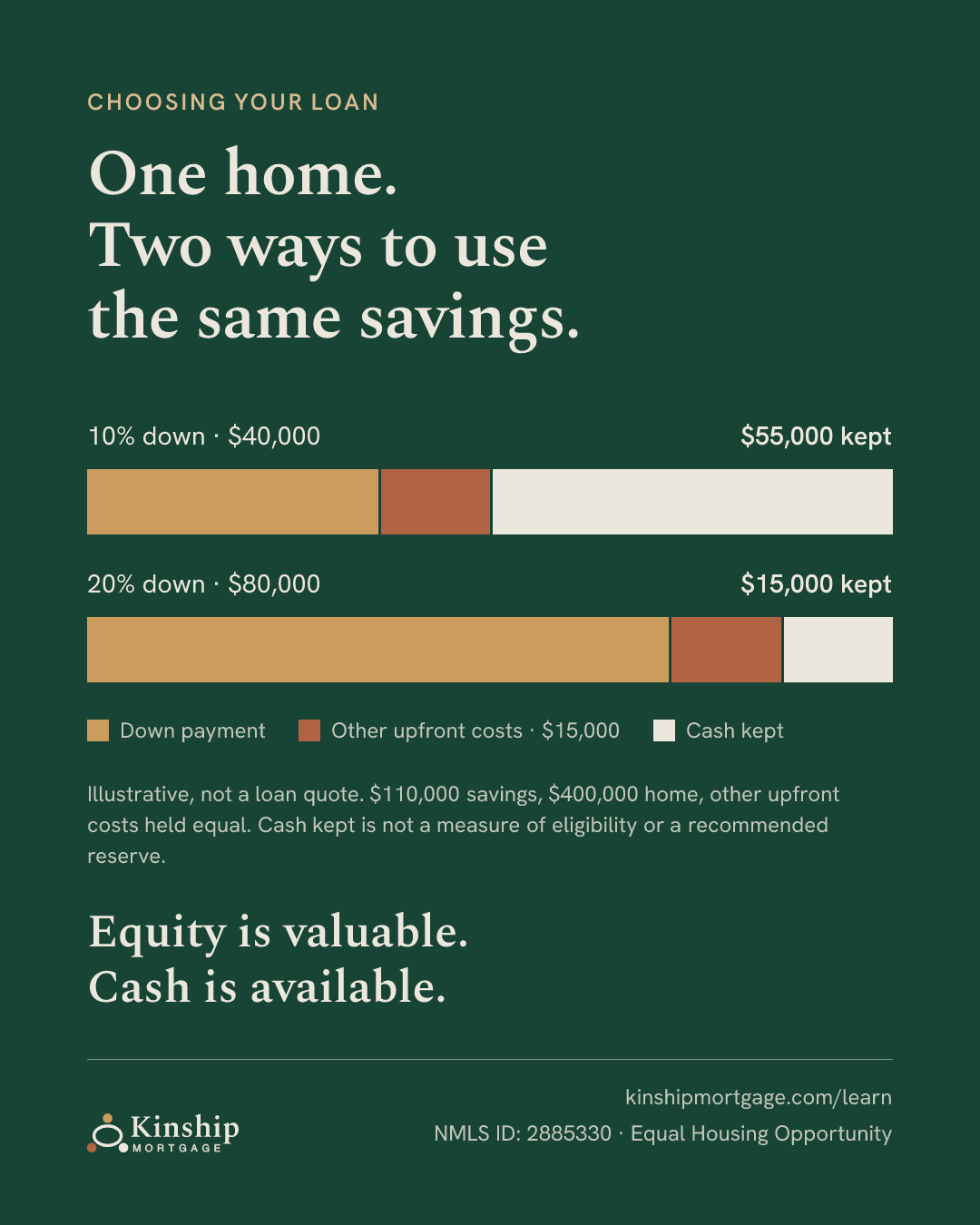
Picture a buyer with $110,000 saved. They’re looking at a $400,000 home and setting aside $15,000 for closing costs and the move. Here is what’s left at each down payment.
One home. Two ways to use the same savings.
-
10% down · $40,000 $55,000 kept
Of $110,000 saved: $40,000 down payment, $15,000 other upfront costs, $55,000 kept.
-
20% down · $80,000 $15,000 kept
Of $110,000 saved: $80,000 down payment, $15,000 other upfront costs, $15,000 kept.
$40,000 more in the home.
$40,000 less for life after closing.
Imagine the water heater fails in your second month.
Same house, same buyer. With $55,000 kept, it’s an inconvenience. With $15,000, it’s a real decision about what else to put off. Neither down payment is wrong. They buy different kinds of security.
03 · Your decision
Choose the payment and the cushion together, not one at a time.
Three questions help. Bring them to any mortgage conversation.
- What do I want to keep available?
- Set aside known expenses and an emergency cushion first. Treat only the rest as down payment.
- What changes in the full monthly payment?
- Compare principal, interest, mortgage insurance, taxes, insurance, and HOA dues. Ask for quotes on the same home and term at each down payment.
- Does either option make the rest of life too tight?
- If both feel uncomfortable, the answer may be the price range or the timing, not the down payment.